Daniel Ashbrook, PhD
About
 I am an Associate Professor in the Human-Centered Computing section of the Department of Computer Science at the University of Copenhagen in Copenhagen, Denmark.
Contact information
dan@di.ku.dk
Calendar
University of Copenhagen
Department of Computer Science
Sigurdsgade 41, Office 0.07
2200 Copenhagen N
Denmark
I graduated in 2010 with my Ph.D. in Computer Science from the School of Interactive Computing at Georgia Tech. Subsequently, I worked for Nokia Research and Samsung Research before returning to academia in 2014.
From 2014–2018 I was an Assistant Professor in the Department of Information Sciences and Technologies and the Department of Computer Science of the Golisano College of Computing and Information Sciences at the Rochester Institute of Technology (RIT) in Rochester, New York, USA.
You can download my CV here.
Research
My research is in the area of human-computer interaction, where I concentrate on new interaction techniques, devices, and applications. Historically I concentrated on wearable and mobile computing, with the goal of allowing people to be less focused on their technology and more engaged with the world, while still reaping the creativity and productivity benefits of their devices. My current research continues this thread while adding a second focus on helping non-experts more easily understand and use personal fabrication technology such as 3D printers, laser cutters, and CNC routers.
My research has been supported by HP, Nokia, and the United States National Science Foundation.
Publications
You can see a full list of my publications on my Google Scholar profile page; here is a recent selection:
-
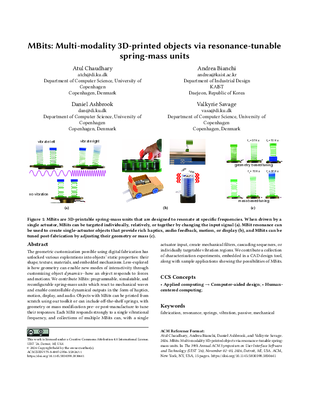
MBits: Multi-modality 3D-printed objects via resonance-tunable spring-mass units
 Proceedings of the 39th Annual ACM Symposium on User Interface Software and Technology • 2026, pp1–15 • 10.1145/3830398.3830641
Abstract
The geometric customization possible using digital fabrication has unlocked various explorations into objects’ static properties: their shape, texture, materials, and embedded mechanisms. Less-explored is how geometry can enable new modes of interactivity through customizing object dynamics—how an object responds to forces and motions. We contribute MBits: programmable, simulatable, and reconfigurable spring-mass units which react to mechanical waves and enable controllable dynamical outputs in the form of haptics, motion, display, and audio. Objects with MBits can be printed from scratch using our toolkit or can include off-the-shelf springs, with geometry or mass modification preor post-manufacture to tune their responses. Each MBit responds strongly to a single vibrational frequency, and collections of multiple MBits can, with a single actuator input, create mechanical filters, cascading sequences, or individually targetable vibration regions. We contribute a collection of characterization experiments, embedded in a CAD design tool, along with sample applications showing the possibilities of MBits. -
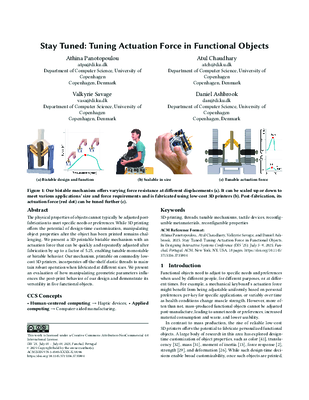
Stay Tuned: Tuning Actuation Force in Functional Objects
 Proceedings of the 2025 ACM Designing Interactive Systems Conference • 2025, pp2485–2502 • 10.1145/3715336.3735804
Abstract
The physical properties of objects cannot typically be adjusted post-fabrication to meet specific needs or preferences. While 3D printing offers the potential of design-time customization, manipulating object properties after the object has been printed remains challenging. We present a 3D printable bistable mechanism with an actuation force that can be quickly and repeatedly adjusted after fabrication by up to a factor of 5.25, enabling tunable monostable or bistable behavior. Our mechanism, printable on commodity low-cost 3D printers, incorporates off-the-shelf elastic threads to maintain robust operation when fabricated at different sizes. We present an evaluation of how manipulating geometric parameters influences the post-print behavior of our design and demonstrate its versatility in five functional objects. -
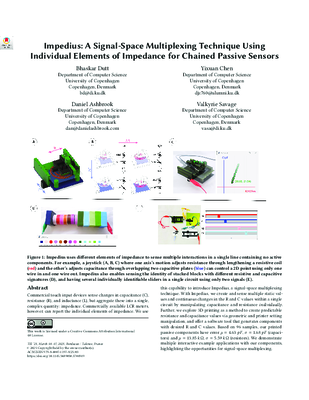
Impedius: A Signal-Space Multiplexing Technique Using Individual Elements of Impedance for Chained Passive Sensors
 TEI '25: Proceedings of the Nineteenth International Conference on Tangible, Embedded, and Embodied Interaction • 2025, pp1–11 • 10.1145/3689050.3704949
Abstract
Commercial touch input devices sense changes in capacitance (C), resistance (R), and inductance (L), but aggregate these into a single, complex quantity: impedance. Commercially available LCR meters, however, can report the individual elements of impedance. We use this capability to introduce Impedius, a signal-space multiplexing technique. With Impedius, we create and sense multiple static values and continuous changes in the R and C values within a single circuit by manipulating capacitance and resistance individually. Further, we explore 3D printing as a method to create predictable resistance and capacitance values via geometric and printer setting manipulation, and offer a software tool that generates components with desired R and C values. Based on 96 samples, our printed passive components have error μ = 4.63 pF, σ = 1.68 pF (capacitors) and μ = 13.85 kΩ, σ = 5.59 kΩ (resistors). We demonstrate multiple interactive example applications with our components, highlighting the opportunities for signal-space multiplexing. -
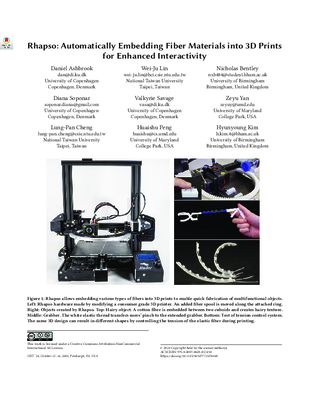
Rhapso: Automatically Embedding Fiber Materials into 3D Prints for Enhanced Interactivity
 UIST '24: Proceedings of the 37th Annual ACM Symposium on User Interface Software and Technology • 2024, pp1–20 • 10.1145/3654777.3676468
Abstract
We introduce Rhapso, a 3D printing system designed to embed a diverse range of continuous fiber materials within 3D objects during the printing process. This approach enables integrating properties like tensile strength, force storage and transmission, or aesthetic and tactile characteristics, directly into low-cost thermoplastic 3D prints. These functional objects can have intricate actuation, self-assembly, and sensing capabilities with little to no manual intervention. To achieve this, we modify a low-cost Fused Filament Fabrication (FFF) 3D printer, adding a stepper motor-controlled fiber spool mechanism on a gear ring above the print bed. In addition to hardware, we provide parsing software for precise fiber placement, which generates G-code for printer operation. To illustrate the versatility of our system, we present applications that showcase its extensive design potential. Additionally, we offer comprehensive documentation and open designs, empowering others to replicate our system and explore its possibilities. -
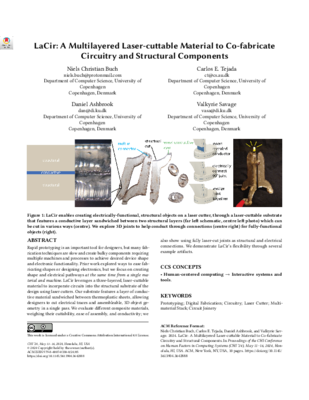
LaCir: A multilayered laser-cuttable material to co-fabricate circuitry and structural components.
 CHI '24: Proceedings of the CHI Conference on Human Factors in Computing Systems • 2024, pp1–10 • 10.1145/3613904.3642888
Abstract
Rapid prototyping is an important tool for designers, but many fabrication techniques are slow and create bulky components requiring multiple machines and processes to achieve desired device shape and electronic functionality. Prior work explored ways to ease fabricating shapes or designing electronics, but we focus on creating shape and electrical pathways at the same time from a single material and machine. LaCir leverages a three-layered, laser-cuttable material to incorporate circuits into the structural substrate of the design using laser cutters. Our substrate features a layer of conductive material sandwiched between thermoplastic sheets, allowing designers to cut electrical traces and assembleable, 3D object geometry in a single pass. We evaluate different composite materials, weighing their cuttability, ease of assembly, and conductivity; we also show using fully laser-cut joints as structural and electrical connections. We demonstrate LaCir’s flexibility through several example artifacts.
Teaching
User Interface Technology (2020–present)
User Interface Technology is a Master-level course in the Computer Science department which focuses on technology for modern and emerging user interfaces and hardware, with an emphasis on physical computing.
Digital Fabrication and Makerspace Skills for Science (2025–present)
Digital Fabrication and Makerspace Skills for Science is a Bachelor-level course in the Computer Science department, which focuses on digital fabrication machines (like 3D printers and laser cutters) and electronic sensing technologies (like Arduinos and infrared cameras), and their ability to support research and laboratory tasks in various fields of science.
Introduction to HCI (starting 2027)
This course in Human-Computer Interaction is part of the University of Copenhagen’s BA in Communication and Information Technology.
Human-Computer Interaction @ DIS Study Abroad (2025–present)
This semester-long course in Human-Computer Interaction is offered by DIS, a non-profit study-abroad institution for north-American university students.
For current students at KU
Are you interested in working with me? First, read this page of advice for prospective students for more information on how to contact me and what to expect.
Then:
- For Master students: are you considering doing your thesis with me? Read my notes on you and your thesis and have a look at my list of potential research projects.
- For Bachelor students: are you considering doing your final project with me? Read some advice for BSc project students and have a look at my list of potential research projects.
For prospective students not at KU
If you’re not currently a student at the University of Copenhagen, I probably can’t do much to help:
- Potential PhD students: unforunately I don’t currently have any open PhD positions. You can find currently availalbe PhD postings at the DIKU vacancies page.
- Potential MSc/BSc students: I don’t have any insight into or influence over the admissions process. Feel free to contact me once you’re enrolled at the university!
- Potential interns: I’m tentatively open to students coming as interns, however I have no funding for this purpose. If you are funded by your home university and are interested, please read my page of advice for prospective students for more information on how to contact me.